
Porsche 963 LMDH & RSP WIP
Current Tri-count: 29,908
During my time working for Napster (formerly Infinite Reality), we often obtained assets from sources like turbosquid and processed them from their exported format to UE5. This was usually done to save time on high-detail / high-importance assets that needed to be used for projects with quick turnarounds. While this always worked for our usecases, many times these models were prepped with specific shots in mind, and camera distance accounted for.


I was commissioned to recreate this Porsche 963 Le Mans livery for a vignette we created targeting TAG Heuer. The original model and UVs held up well up to within 6 feet of the camera and allowed me to reproduce the entire livery within a day. However, up-close, the original model did not hold up to AAA standards. Portions of the vehicles design were either completely missing or incorrect, UVs were overly optimized to the point where normal map and albedo detail lost fidelity due to anti-aliasing, the interior was an inaccurate placeholder, and the poly count was far too high when smoothed/subdivided and far too low at its base sub-d.

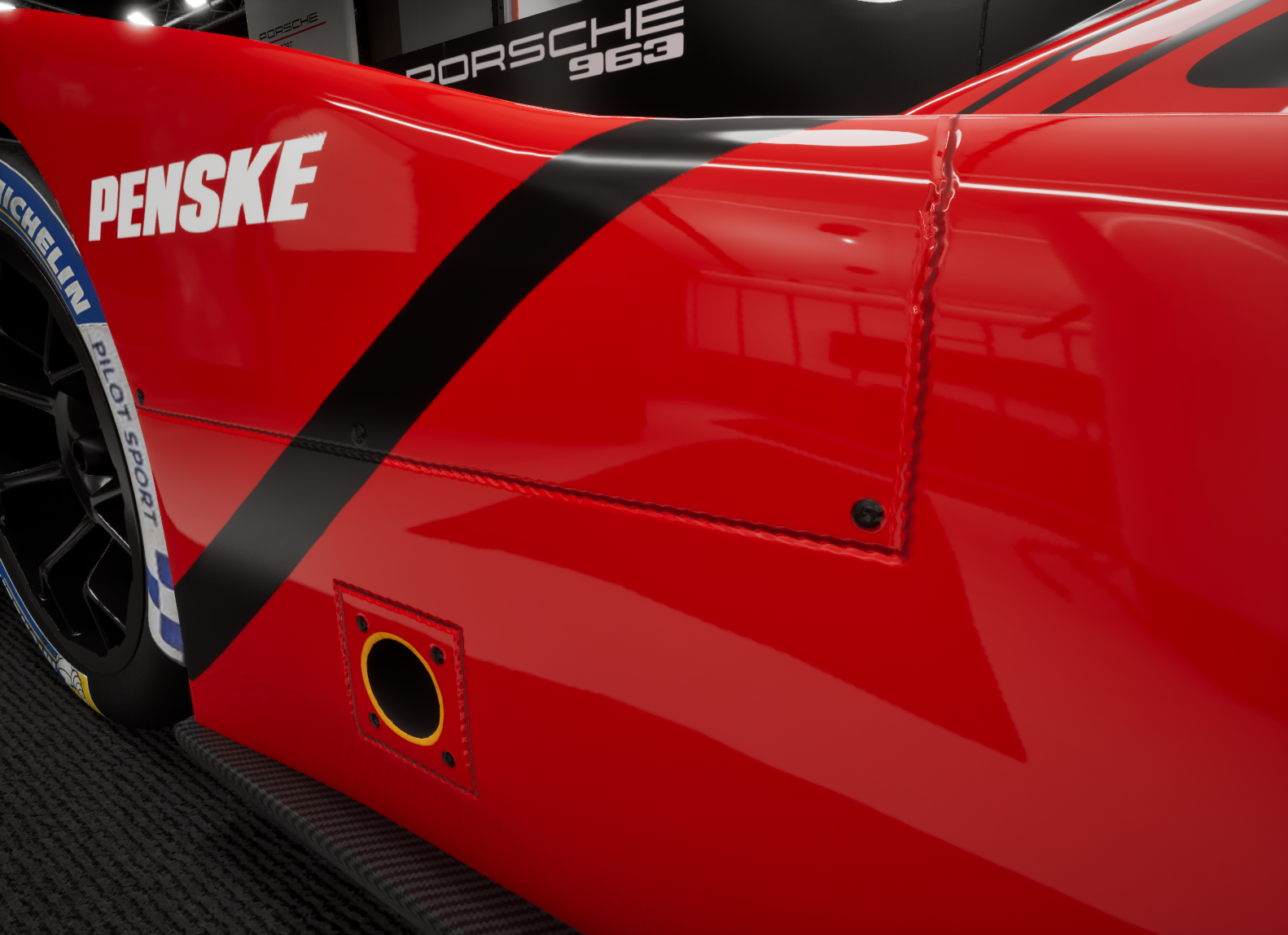

Enter this re-creation project. I was really happy with the work I did recreating the livery and wanted to be able to show it off in high detail, but I needed a strong base model to work with. The plan: Create One. To save a bit of time and remain as accurate as possible, I decided to start with a CAD model, and retopologize or remodel parts of the CAD file to end up with an efficient, high-detail, real-time model that could hold up to near-macro shots in UE5.
As anyone who has processed CAD models to a DCC knows, CAD files or Exports are usually extremely bloated and messy. The CAD for the Porsche 963 contained overlapping proxy meshes that were merged with final topology. Panels were split in random places, likely due to original curve placement or artifacts from conversion to meshes from NURBS surfaces. Topology and mesh count was high enough to slow Maya to a crawl (which is not necessarily difficult to do ^_^). So, the first order of business was to drop the CAD into 3dsMax and optimize the file into an FBX that would allow me to work efficiently in Maya. This consisted of combining parts, deleting bad geo, as well as removing any repeated or mirrored geometry.


The next step was to begin the tedious process of retopology. I ran tests in blender and zBrush attempting to create a somewhat decent auto-retopology of some of the more organic shapes of the car body. Unhappy with the results, I decided that the only way to have the control and percision that I needed was to retopologize by hand, so, I dove into the seemingly bottomless pit that is Quad-Draw: Tedious, Time-Consuming, Unmatched Final Results.

